Stardew Valley
A one-person indie masterpiece proving you don't need a huge budget to build a game millions are still playing nearly a decade later.
Overview
Stardew Valley opens on an everyday scenario few games would dare build a whole game around: you, a burnt-out office worker in the city, inherit your grandfather’s plot in Stardew Valley, quit your job, move to Pelican Town, and start over. That story resonates with an entire generation worn down by the corporate grind — which is exactly why it works.
Behind the simple premise stands one of the most successful indie games in history: more than 41 million copies sold, made by one person — Eric Barone, better known as ConcernedApe — who wrote the code, drew the pixel art, composed the music, and designed everything himself over four and a half years of working alone. No studio, no team, just one person with the idea of “remaking Harvest Moon the way I want it.”
Gameplay Highlights
The core loop is: plant, water, harvest, sell, buy better seeds, expand the farm. It sounds simple, but Stardew layers dozens of interlocking systems on top so you never run out of things to do. The farm is just the first piece: you can raise chickens, cows, and ducks, keep bees for honey, brew fruit wine, set crab traps on the beach, chop wood and mine ore, cook, fish, and forage herbs in the woods.
Weather and the four seasons — spring, summer, fall, winter — set the entire rhythm of play. Each season lasts 28 days, crops are season-specific, and since almost nothing grows in winter, it’s your cue to pivot to ranching, mining, or befriending the town. Stardew’s cleverness is that every season has its own activities — there’s no true dead time.
And then there are the townsfolk: Pelican Town has more than 30 residents with their own daily schedules, each with their own tastes, stories, and secrets. You can befriend, date, and marry one of twelve candidates — from Shane, the depressed, hard-drinking farmhand, to Leah, the reclusive artist, to Sebastian, the night-owl programmer. Many personal storylines tackle addiction, depression, and family estrangement — emotional depth rarely seen in this genre.
The mines are the combat side: 120 floors of rock and monsters in The Mines, plus the Skull Cavern in the desert, where you gather ore, gems, and rare artifacts for crafting. Fighting — just axes, swords, and slingshots — isn’t deep, but that’s by design: it’s one thing you do among many, not the centerpiece.
The skill system spreads across farming, mining, fishing, combat, and foraging, with each branch unlocking new crafting recipes as you level up. Layer on the choice between restoring the Community Center or siding with JojaMart, and Stardew gives you multiple ways to play the same world.
Four-player multiplayer on a shared farm is a big plus: you take the mines, I’ll tend the crops, and we all cook dinner together back at the house — a cooperative experience no other game quite replaces.
Graphics and Sound
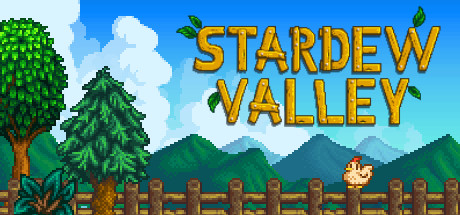
The 16-bit pixel art was hand-drawn by Barone himself, and every tile has character. It’s not flashy, but it’s honest: rice paddies turning gold in fall, snow falling in winter, the Winter Star festival lanterns glowing after dark. The music is Barone’s too — gentle acoustic piano pieces, one signature track per season — and strangely, hundreds of hours in, it never gets old.
Long-Term Experience
Few games age as gracefully as Stardew Valley. The 1.6 update arrived free in 2024 — eight years after launch — adding new farm events, the Meadowlands area, new crops and festivals, plus hundreds of quality-of-life tweaks. Barone still works alone on patches. Your long-term goals: finish the Community Center, max every skill branch, complete the museum and library collections, or try the different farm maps — each with its own challenge, like Four Corners, Beach, or Desert. Add the famously rich PC modding scene, and Stardew Valley is nearly a game without an ending.
Verdict
Stardew Valley isn’t just the best farming game — it’s proof that one person with enough passion can build something that surpasses most team efforts. If you need a game to breathe with after work, a peaceful world that still rewards curiosity, this is about as close to a risk-free purchase as gaming gets.
Pros
- The plant-harvest-reinvest loop is the most addictive in the farming genre.
- A living Pelican Town with dozens of residents on their own schedules and storylines.
- The free 1.6 update added major content eight years after launch.
- Cross-platform with multiplayer supporting four farmers on one farm.
Cons
- Pixel art graphics won't land for players used to modern 3D games.
- A few systems, like mine combat, are shallow compared to the rest.